Strangely Atmospheric: the videos of Shiho Kano

James Benning meets David Lynch?

Earlier this week, I caught a Balagan Film Series event compiling a variety of Japanese experimental films spanning several decades. Among the films shown was Shiho Kano‘s “Rocking Chair” which so intrigued me with it’s evocative sense of mono no aware that I had then look for more of Kano’s work on the Internet. Unhurriedly observational, mundane yet subtly evocative or suggestive, some of Kano’s films, like “Rocking Chair” and “Rosecolored Flower”, seem to have an understated mindfulness or even Continue reading

Open Notebook: The Cambridge Companion to Creative Writing

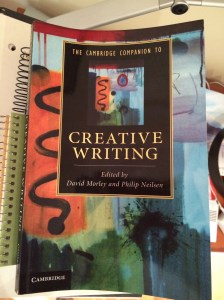
IMG_5141After enjoying David Morley’s fantastic Writing Challenges podcast, I decided to take a look at the book David Morley co-edited with Philip Neilsen, The Cambridge Companion to Creative Writing. Overall, this collection of articles offers some helpful perspectives (ranging from philosophical to practical) and exercises for creative writers. Here are a some lines that resonated with me.

What are you challenging yourself to do that makes it worthwhile for the reader to join you?—Kári Gíslason, “Travel Writing”

Is it not the point of art, both the production and the experience of it,
to transcend your own reality, your own autobiography?—Jewell Parker Rhodes, “Imaginative crossings: trans-global and transcultural narratives”

…to “write what you know” fosters provincialism. —Jewell Parker Rhodes, “Imaginative crossings: trans-global and transcultural narratives”

My admonition is to write what you can dream… write what you wish to discover… write what you need to about human nature. Stories, for me, have always been a wish fulfilment — an opportunity to make my life larger by stimulating my intellect, deepening my empathy, and connecting rather than distancing my self from others.—Jewell Parker Rhodes, “Imaginative crossings: trans-global and transcultural narratives”

…the writing workshop isn’t about being published… it is about being more deeply alive.—A.L. Kennedy, “Does that make sense?”

I currently believe that writing is a way of life, that it is a massively demanding discipline, that it is an almost irresistible source of enrichment, expression and change.—A.L. Kennedy, “Does that make sense?”

Writing consists of a multitude of individual decisions, massive and complex control of language in depth and considerable personal responsibility…—A.L. Kennedy, “Does that make sense?”

Continue reading

Just Watched: Men, Women and Children

When I ran across this clip from the latest Jason Reitman film, I knew I had to see Men, Women and Children. In just under a minute, this bit of dialogue nicely alludes to cultural shifts related to the roles of Internet technologies in our lives, while also capturing a sense of that uniquely adolescent mixture of genuineness, irritation and sarcasm. After seeing Men, Women and Children, I now find this clip to be a deft microcosm of the film’s themes and approach to them, so much so that the full scene could have been a satisfying short film.


At times, Men, Women and Children can feel like a sprawling collage of characters and Internet-mediated interactions, but ultimately plotlines and motifs shape up to convey a compelling (though not necessarily coherent) picture of our relationships with each other and with information technology. The Verge summed it up nicely in the subtitle of their review:

a movie that gets the internet right

Though excellent as a film with relatable characters who reveal the facets of human nature that social media and the web can engender, facilitate, problematize, Continue reading

Just Read: The Meaning of Human Existence

Exalted we are, risen to be the mind of the biosphere without a doubt, our spirits uniquely capable of awe and ever more breathtaking leaps of imagination. But we are still part of Earth’s fauna and flora, bound to it by emotion, physiology, and, not least, deep history. It is folly to think of this planet as a way station to a better world.

Picking up where The Social Conquest of Earth left off, EO Wilson continues to tell the story of humanity in The Meaning of Human Existence. With such a suggestive title, this book could very be about humanity’s destiny, and while there is certainly some discussion of that, of our potential as a species, this book feels to me largely concerned with what it means to be human from a variety of perspectives.

Although you may not come away with a sense of what our purpose is, reading this book is tremendously worthwhile, even (or especially?) Continue reading

A Better World by Design 2014, the Real Payoff

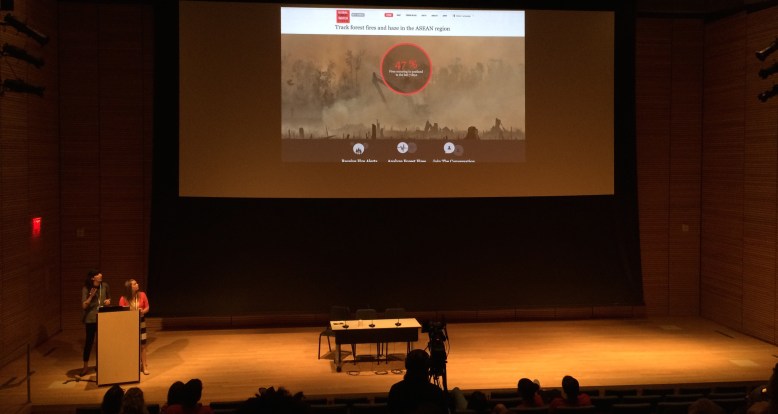
Global Forest Watch presents at A Better World by Design
Now I know for sure that attending A Better World by Design (AWBxD) this year was well worth it. When I talked with my students who were able to attend this design conference in Providence, Rhode Island, there was palpable excitement. All but two of my intro to environmental science students made it to ABWxD, and we had a blast sharing the things that really stood out to us during those 3 days of talks and workshopes on the Brown University and RISD campuses, like these…

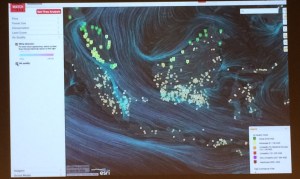
Global Forest Watch tracks forest fires and wind patternsSarah Mann Carolyn Ciciarelli from Global Forest Watch showed us their interactive web platform for examining deforestation, forest fires and more—an amazing way to look at tree data all over the world. Global Forest Watch also makes APIs that allow people to utilize forest data for their own specific analyses. The blurry image here shows how their platform couples forest fire and wind data to provide insights on air quality—AWESOME! 

Ellen Jorgensen told us about the DIY biology lab in New York Genspace and Continue reading

Perfect! Well, almost… Ramen at Yume Wo Katare

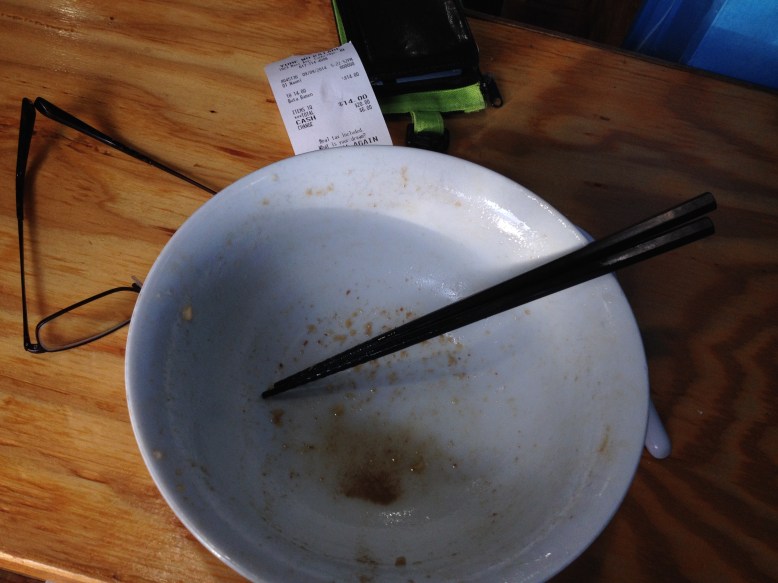
Can't believe I finished it all...
If you don’t know what was in the bowl shown above 20 minutes before I took this picture, you can find out by visiting Yume Wo Katare or by checking out their Yelp! review photos. I can’t believe I packed just about everything that was in there into my stomach. That earned me a “Perfect!” from that ramen shop’s staff and fellow customers. Admittedly, this cheer of affirmation did feel good, but it’s not a feeling I’m inclined to seek out again since it came with some discomfort…

I love the idea the staff of Yume Wo Katare regularly declare while you dine there: harness the same gusto it takes to devour a monster bowl of ramen to accomplish your dreams. And I love the culture too; it’s a cozy, friendly place where you’re encouraged to announce to your fellow customers who you are and what your dream is after you’ve eaten what you can of the massive serving of broth, noodles and pork. You’re also given hearty encouragement on what you’ve shared (often applause) and on your ramen-scarfing abilities—if you can’t make it to the bottom of the bowl, you’ll be awarded with “Good Job!” or “Next Time!” depending on how far you got.

But while the noodles are wide and chewy, the broth is really oily and a little too salty for my taste. The bits of fat in the soup, though tasty, also make the soup less appealing to quaff, let alone drink in its entirety. At first, the bowl of ramen set before me looked manageable, but once I made my way through 70% of the noodles and 20% of the broth, I found myself fighting the feeling of extreme fullness to continue on the rest of the way.

I really wanted to hear the guys say “Perfect!” and not waste food, so I struggled to and did finish my order of ぶたラーメン, but next time I have a hankering for ramen, I’ll likely settle for “Good Job!” or go to Sapporo Ramen down the street instead.

Here’s recent NPR’s story on Yume Wo Katare which gives an auditory glimpse into the atmosphere of this unique ramen spot.

Open Notebook: quotes from The Organized Mind

Quotes from the fantastic book The Organized Mind (points that were particularly interesting to me are in bold).
The Organized Mind at the Harvard BookstoreChapter 1

Satisficing is one of the foundations of productive human behavior; it prevails when we don’t waste time on decisions that don’t matter, or more accurately, when we don’t waste time trying to find improvements that are not going to make a significant difference in our happiness or satisfaction.

…satisficing is a tool for not wasting time on things that are not your highest priority…

…unproductivity and loss of drive can result from decision overload.

The decision-making network in our brain doesn’t prioritize.

Every status update you read on Facebook, every tweet or text message you get from a friend, is competing for resources in your brain with important things like whether to put your savings in stocks or bonds, where you left your passport, or how best to reconcile with a close friend you just had an argument with.

Attention is the most essential mental resource for any organism. It determines which aspects of the environment we deal with, and most of the time, various automatic, subconscious processes make the correct choice about what gets passed through to our conscious awareness.

…attentional switching. We can state the principle this way: Switching attention comes with a high cost.

Our brains evolved to focus on one thing at a time.

The formation of categories in humans is guided by a cognitive principle of wanting to encode as much information as possible with the least possible effort

We are hardwired to impose structure on the world

…shift the burden of organizing from our brains to the external world. Continue reading

Exploring Livable Streets, Environmental Art and Workspace Layout at A Better World By Design 2014

So back in the summer, I was trying to decide whether I should attend if it’s worthwhile to attend the design conference A Better World by Design (AWBxD). Now, here I am on the campuses of RISD and Brown University attending conference talks and workshops! While some of the workshops are quite amateur in nature (i.e. feel not well developed and not well facilitated), some of the ABWxD speaker sessions and other workshops have been fantastic. Here are a few of my faves so far…

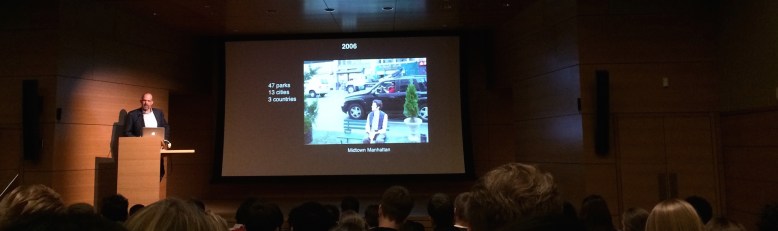
Aaron Naparstek got us well acquainted with livable streets, showcasing some amazing urban re-design work from around he world and particularly in NYC, improvements to cities that allow them to better integrate bicycles, pedestrians and green space to become more lively.

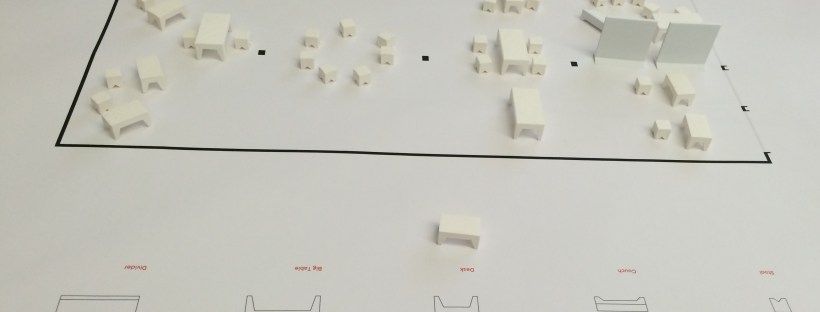
The folks from Work-Shop kicked of their session by giving us a super-basic floor plan and 3D-printed model furniture and having us work in small groups Continue reading