Still hilarious and awesome. When the origami showdown gets under way at three minutes in, fantastic.
Category: appreciation
The Travails of Takemoto: Honey & Clover and Self-Actualization
If I find my own way, how much will I find? …Will I find you?
That’s the question intensely and even agonizingly posed by Joseph Arthur’s “In the Sun”, a question the anime Honey & Clover explores and answers for at least one of its characters. Does figuring out where we have to go or where we have to be us bring us closer to those we care about?
Although this anime series is almost ten years old now and is almost claustrophobically small in its world of self-absorbed college students, Honey & Clover is still quite an odyssey into personal circumstances that middle-class, creative millennials can relate to—a journey that attempts and sometimes manages to navigate the challenges of creativity, career, romance, loss, identity, belonging, friendship, family—you know, growing up.
That’s what made Honey & Clover so compelling; if you could buy into Continue reading
Hedgehog’s Dilemma—Just Read: Say What You Will
“WHY DID YOU APPLY FOR THIS JOB?”
“Because I wanted it. I thought helping someone else might take me out of my head for a while.”
Amy’s head bent down as she typed for a minute. Then she rethought what she’d written, pushed delete, and typed something else. “THAT’S EXACTLY HOW I FEEL.”
There’s so much packed into this recently released novel, it’s like Stargirl meets Juno… meets Beautiful Life? Regardless of what this engrossing work of YA lit reminds me of, Say What You Will feels uniquely epic in the sweep of emotions and situations it quickly draws the reader into. While the characters and their situations can be very, um, adolescent, the insights they offer into human thoughts and needs are perhaps timeless; sometimes we end up saving ourselves by trying to save those we care about; sometimes silence, whether easy or hard to break, can corrosively persist between us if we default to passivity; sometimes we’ll push away those care about by trying to draw them closer.
If you spot this in a bookstore or have a moment to use Amazon’s “look inside” feature, give the first few pages a read. After I did, I had to read the whole thing and wound up being taken by it to unexpected places, including back to my alma maters.
When this book is turned into a major motion picture, Allison Weiss‘s “I Was An Island” must be in the soundtrack.
Ancient Psychic Tandem War Elephant: Adventure Time and Self-Actualization
For now, I am the match and the candle.
Shram, it’s crazy how in under 15 minutes Adventure Time can pull so many heartstrings and be so much fun. I just love this touching moment between Finn and the Ancient Psychic Tandem War Elephant in “Something Big”—wacky but so real, so humanistic.
Should I Go To A Better World by Design 2014?
 Early bird registration closes soon for one of my favorite conferences, A Better World by Design (ABWxD). To me, it tops even MIT Technology Review’s heady (swanky, even) EmTech experience of being within meters of tech revolutionaries at MIT’s Media Lab. Because ABWxD is an extremely engaging, active experience with interactive, well-facilitated problem-solving workshops and charismatic keynote speakers who have spoken passionately about the role of effective design in a variety of fields ranging from sustainability and health to urban development and education. It’s not just invigorating but also empowering. But do I really want to go once again to drink the design thinking Kool-Aid?
The first part of Decisive‘s WRAP framework is Widen Your Options, so the question shouldn’t be “whether or not to attend A Better World by Design”; to escape narrow framing, consider what am I or should I be comparing this amazing conference experience to? Well, for the $165 early bird registration cost for 3 days of ABWxD excitement, I could…
– get a Remee lucid dreaming sleep mask and up my commitment to my decades long interest in lucid dreaming;
– get a third of an iPad mini (but easily a whole iPad mini and then some after considering transportation and lodging costs);
– take a day or overnight trip to the White Mountains; Continue reading
Before Sunrise meets Last Year in Marienbad… meets The Passenger?
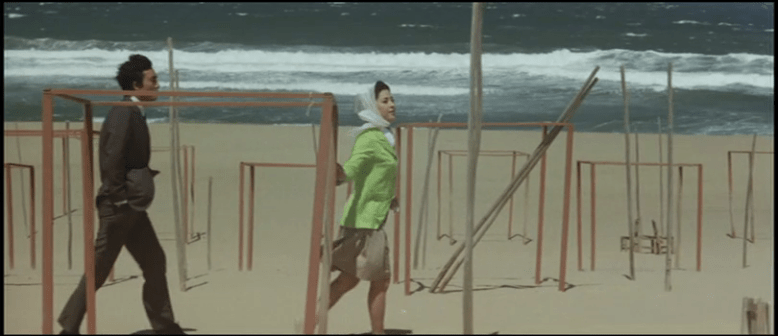
Since catching a number of the screenings during the Kiju Yoshida and Mariko Okada retrospective at the Harvard Film Archive, I’ve been wanting to see さらば夏の光 (saraba natsu no hikari, aka Farewell to the Summer Light), which seems to have a reputation for being Yoshida’s artsiest work. A couple weeks ago, I got the film on DVD and finally immersed myself in this, indeed, artsy cinematic experience. I’m glad I had a chance to watch Farewell, but in the end, I am left to regard it as an ambitious work that resonates with its Japanese and French New Wave contemporaries while falling short of its aspirations and promise.
The film is essentially like the situations and female-male duos of the stunning films Before Sunrise and Last Year in Marienbad were morphed together and played out over a variety of European countries (with an aesthetic somewhat reminiscent of The Passenger); we’re launched right into this exciting proposition—the meeting of two travelers dislocated from their native culture in visually enthralling environs, then further dislocated from the mundane logic of reality in a Murakamian maze of emotions gone metaphysically awry.
But the evocative, epic Farewell to the Summer Light soon falls short of its initial, fantastical potential. The visually luscious scenes in vivid European settings, images oozing with symbolism, philosophical musings, enigmatic characters, wistful, almost melancholy theme song—it seems like all the elements are present to make this film an extraordinary, fanciful psychological odyssey, but the assembly of these components is toppled by irritating distractions: the obvious, curious gazing of passersby into the camera, the peculiarly lilting English of the supposedly American characters, the cliché inevitability of romantic tension then involvement then extreme idealization.
And yet, Farewell to the Summer Light still has a magic and power that lingers on after the almost climactic, then ultimately anticlimactic ending. There’s something compelling about the idea characters meeting over and over, especially in some seemingly significance-laden setting (a scenario captured with eerie claustrophobia, stylized elegance and overt, poetic theatrics in Last Year in Marienbad). Is it because in our minds we sometimes keep coming back to certain people, meeting them time and time again in the course of our thoughts, even if not in the course of our lives?
Tau over Pi? (Yes, Me) 2
Just found Vi Hart‘s compelling video (below) via Scientific American, and it’s got me close to convinced that we’re better off with tau instead of pi. I’ll have to check out Michael Hartl’s The Tau Manifesto later which will probably clinch this for me…
My Faves in Portland, OR
The Hoyt Arboretum: an extensive network of trails through an impressive collection of tree specimens; the redwoods are spectacular (take a moment to feel the bark of giant sequoia).
The Portland Japanese Garden: a soothing, meticulously designed and maintained set of horticultural mini-landscapes.
Blue Star Donuts: delicious donuts served up in a crisply minimalist space of glass, metal and wood; it’s like the Apple Store of donut shops.
Chef Naoko Bento Cafe: palate-exhilarating Japanese cuisine prepared with organic ingredients. Continue reading
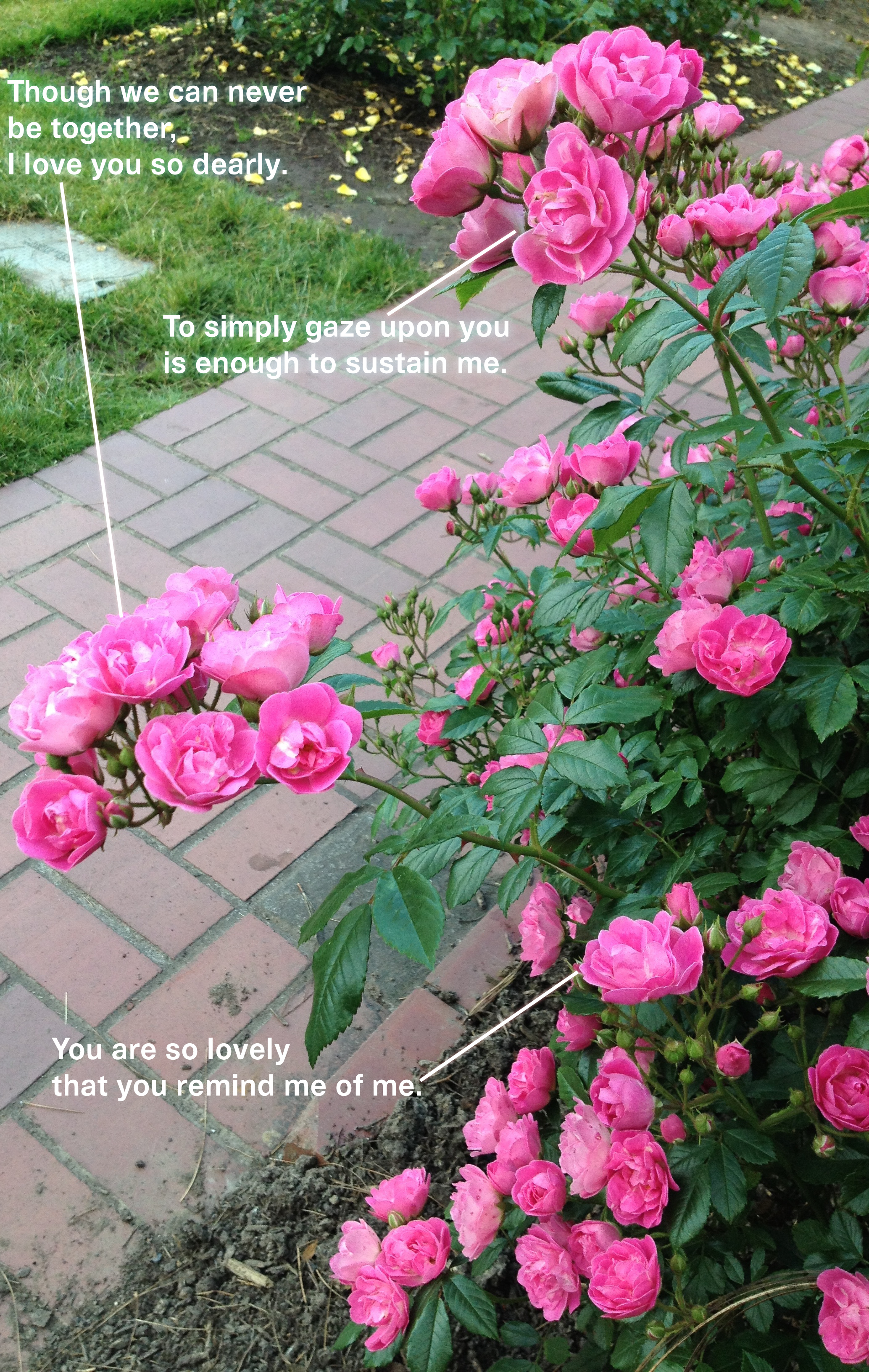
Random Anthropomorphism: Roses
Open Notebook / Just Read: Go Wild

The fascinating and comprehensive evolutionary perspective on human health presented in Go Wild by Dr. John Ratey and Richard Manning compellingly describes the importance of nutrition, exercise, sleep, socializing and contact with nature in our lives. While the tone can seem bombastic at times, the writing brings together a great collection of research findings and stories into an enthralling arc. It’s like The Social Conquest of Earth meets The Wild Life of Our Bodies meets Your Brain on Nature and then some.
Here are some passages from the book I found quite striking.
Humans are the Swiss Army knives of motion.
The evolution of our unique brains was locked into the evolution of our wide range of movement.
…nomadism, bipedalism, and omnivory—are defining for our entire genus and have accrued over the course of two million years of hominid history.
…the calorie content made available to your body is, in fact, to some degree dependent on the type of bacteria in your digestive system, a population that varies wildly from person to person.
…a study in 2011 showed that eating trans fats greatly increases the risk of clinical depression…
“One researcher in education—not in nutrition—performed a meta-analysis of all peer-reviewed research on proven methods to increase a child’s intelligence (that is, boost academic performance). The conclusion: “Supplementing infants with long-chain polyunsaturated fatty acids [specifically omega-3s], enrolling children in early educational interventions, reading to children in an interactive manner, and sending children to preschool all raise the intelligence of young children.”
Annual per capita sugar consumption in the United States was 5 pounds per person in 1700, 23 pounds in 1800, 70 pounds in 1900, and 152 pounds today. Continue reading
 A Contemplative Compilation