Sesame Street: Once Is Not Enough

http://youtu.be/EuScC0f0OZY

Dang, still resonates like crazy with the values infused into me during my childhood. And I’m not talking about just the “reduce, reuse, recycle” mantra; the whole milieu of this muppet-sung message is so 70s and 80s Americana—the family, their clothing, their kitchen, the appliances, the grocery shopping… so wonderfully familiar and even endearing.

For me, once is never enough to relish the quirky magic of this bit of Sesame Street.

Summer Reading Suggestions: Nonfiction

Looking for a beach-bag, in-flight or in-hammock book that offers cutting-edge, even actionable ideas, instead of literary escapism? Here are some paradigm-shifting books I have been enthralled by and continue to use personally and professionally. Enjoy!

Creative Productivity

Glimmer (aka CAD Monkeys, Dinosaur Babies and T-Shaped People)

By 99u.com: Manage Your Day-to-Day, Maximize Your Potential—excellent guidance on how to be an effective creative professional

Steal Like an Artist

Getting the Right Work Done

Do More Great Work—the workbook for making the work you care about even better

The Nature of Thought, Human Behavior and the World

The Heath Brothers Trilogy: Made to Stick, Switch, Decisive—effective strategies for communicating, driving behavioral change and making decisions based on psychology research, explained clearly with compelling stories

The Social Conquest of Earth—the story of who we are as species, why we can be so kind and so hostile (http://www.npr.org/2012/04/13/150575003/how-humans-and-insects-conquered-the-earth)

Your Brain on Nature—how we’re healthier with nature (and some explanation of why)

Leaders Eat Lastthe anthropology and neurobiology of leadership

Imagine, how creativity works (http://www.npr.org/2012/03/21/148607182/fostering-creativity-and-imagination-in-the-workplace)

Where Good Ideas Come From

The Rise of Supermanthe neurobiology of flow through the lens of extreme sports

Antifragile—systems can be more than resilient; rather than bounce back from disruption, some can be made stronger by it; enter antifragility

Focus: the hidden driver of excellence—“The more you can concentrate, the better you’ll do in anything, because whatever talent you have, you can’t apply it if you’re distracted.” http://www.kqed.org/a/forum/R905131000

The Power of Habit—the anatomy of habits (http://www.npr.org/2012/03/05/147192599/habits-how-they-form-and-how-to-break-them)

The Paradox of Choice—how more choices actually make us less happy (http://www.npr.org/2012/05/02/151881205/the-pursuit-of-happiness)

The Willpower Instinct

Your Brain at Work

Ha! The Science of When and Why We Laugh—“humor is by nature confrontational—sometimes cognitively, sometimes emotionally, and sometimes both” (http://www.npr.org/2014/03/15/289946192/whyd-the-scientist-cross-the-road-to-figure-out-why-youre-laughing)

The Information Diet (http://www.informationdiet.com/; http://www.npr.org/2012/01/14/145101748/is-it-time-for-you-to-go-on-an-information-diet)

The 5 Elements of Effective Thinking

The As If Principle

The Social Animal

Disciplined Entrepreneurship
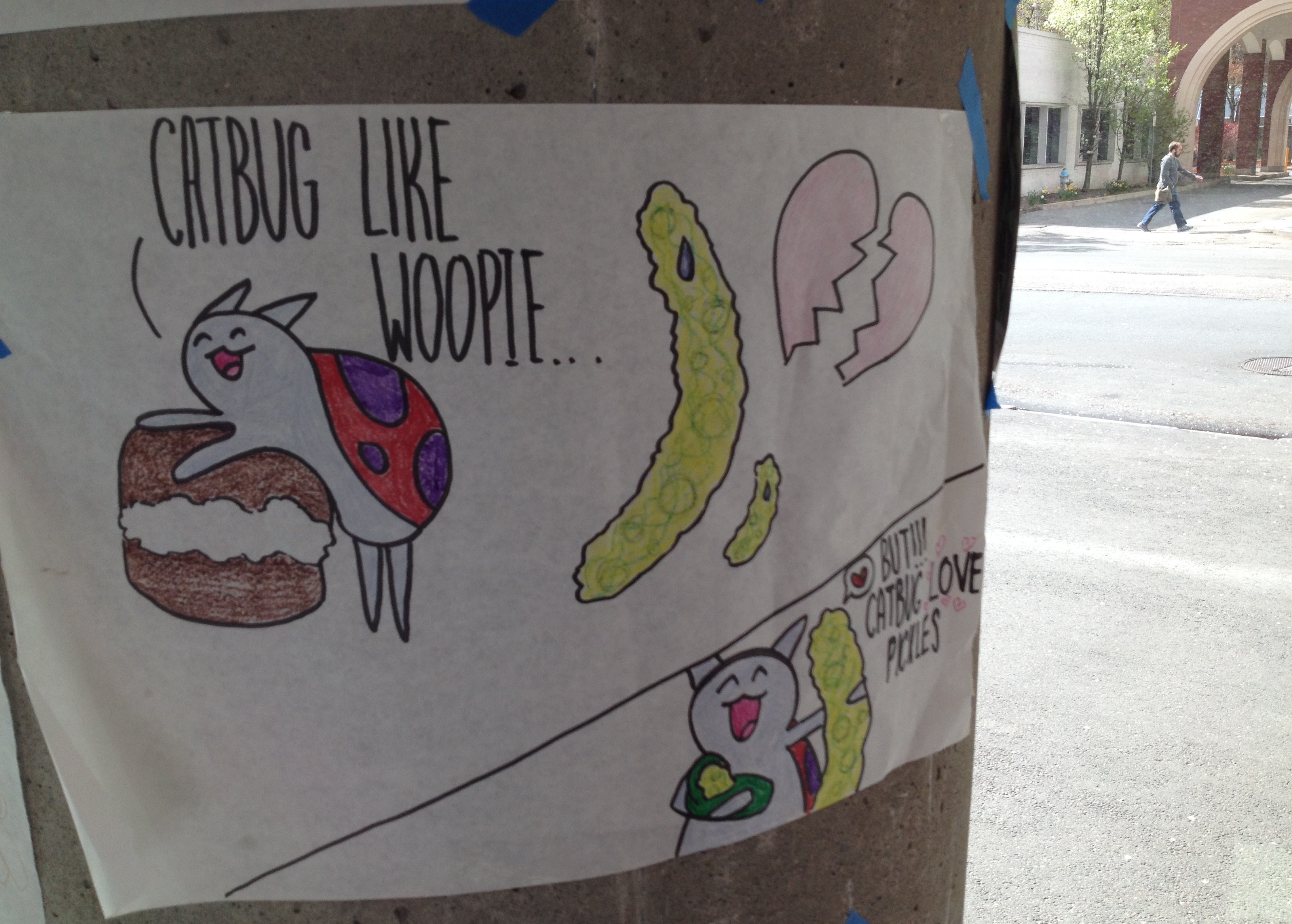
Catbug at Clover KND

Ah, another intersection of Internet culture and everyday life. It was delightful to see this drawing at Clover KND, which has become one of my favorite Kendall Square hangout spots since it opened in recent months—hip minimalist atmosphere with satisfying food, great coffee and delicious sodas.

Catbug drawing at Clover KND

Clover KND

Writers Need Mission Statements Too—Lessons from The Muse and The Marketplace 2014

muse2014posterPushing us to take a hard look at the pursuit of writing as a career, the conference session “The Strategic Writer” provided some realistic, practical perspective for writers in any stage of their development. Led by literary agent Eve Bridburg, the session took us through a framework for approaching writing with clearer purpose and direction, ultimately allowing us to find the viable paths and then select the best ones—reminds me of the quote from Émile-Auguste Chartier shared in Do More Great Work, “Nothing is more dangerous than an idea when it’s the only one you’ve got.”

Two major components of the framework are

  • Define Your Mission: Why do you write? What do you seek to achieve? What impact should your work have?

and

  • Define Success: Qualitatively and quantitatively describe how you’ll know you’re achieving the mission. In doing so, think about what gives enriches your life and you energy; don’t set a target that doesn’t resonate with you (e.g. having 2,000 followers on Twitter when you hate tweeting). For example, if knowing you’ve connected with readers helps sustain your spirits and work, make sure you have at least one way to hear from them that works for you; as one attendee said, a handful of positive emails can actually be powerful indicator that you’ve achieved or are on your way to achieving your mission of sharing valuable perspectives.

These points Eve discussed immediately reminded me of concepts from the invaluable books Made to Stick and Switch, especially

  • the core: clearly capture and convey the essence of your idea

and

  • point to the destination: have a picture of what the near future looks like if your goal is achieved.

The session also resonated with points made in Kevin Starr’s PopTech talk “Lasting Impact” which I require all of my Intro to Environmental Science students watch and apply. Clarity of mission can make all the difference.

Kevin Starr: Lasting Impact from PopTech on Vimeo.