




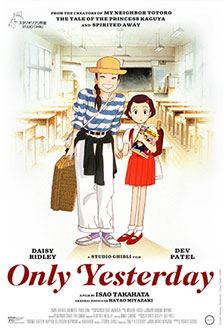
 This beautiful, nostalgic film is in select US theaters, and if you like Studio Ghbili’s work and anime that captures the magic in the quotidian, you should seriously consider seeing Only Yesterday (おもひでぽろぽろ). I love the way the film immerses viewers in Japan of the early 80s and mid 60s to reveal the quiet unfolding of protagonist Taeko’s quarter life crisis in connection to seminal moments of her childhood. This Studio Ghibli gem has a way of capturing that feeling of 物の哀れ (mono no aware)—the transience of things. Whether it’s work in the safflower fields or conversations with family, scenes of Taeko’s present and childhood (the latter shown in pastel shades as if faded with time, sometimes playing out amidst almost dreamy watercolor backgrounds) have so much… presence and immediacy, yet everything is ultimately in flux, including Taeko’s seemingly timeless, idyllic vacation helping her extended family with their farming.
On the one hand, the story presents Taeko with a contrast (then choice) between urban and rural lifestyles, and on the other hand, the story affords an attempt to reconcile past and present selves. On all levels, it’s splendid storytelling that I’ve been able to further appreciate with successive viewings.
If you’re comfortable reading subtitles or willing to push yourself to do so, the subbed version is the way to go.
Though brief, this story by Simona Ciraolo is an endearingly poetic consideration of the changes in the dynamics between siblings as they grow up.

Another kind of magical realism.
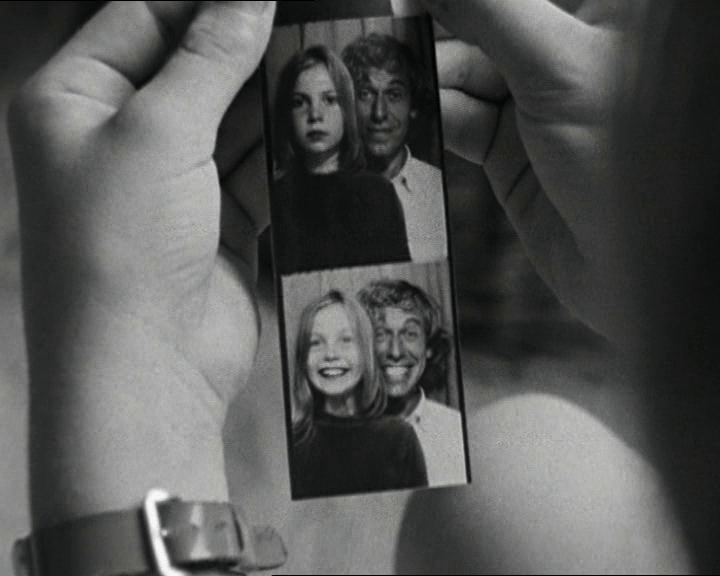
A film so realistic that it captures those magical moments between two strangers becoming more than that.
Once again, expatriates roam European cities and existential territory, but this time, moving through the latter all happens naturally and implicitly. The film grapples with the ideas of human belonging, connection and responsibility but always keeps them in the concrete forms of characters’ actions and interactions; it’s practically all “show” and little if any “tell” with regards to the psychology of the characters. Moments when Philip and Alice yell at each other or become distracted or try to share things with one another, these slivers of time are inhabited by personality traits pushed and pulled out of the psyche and into reality by the vicissitudes of their journey.
I hope Alice In The Cities soon joins the other films of Wim Wenders available in the US from The Criterion Collection.
Maybe it was the recent Hidden Brain episode on Maya Shankar’s path from violin virtuoso to policymaker, or perhaps it was numerous viewings of Seijun Suzuki’s avant-garde film of the same name, but whatever the reason, I’ve gotten rather intrigued by various recordings of Pablo de Sarasate’s “Zigeunerweissen”—just tumbling headlong down the rabbit hole of its insanely fast ending with that mind-blowing pizzicato. Each performance by virtuoso violinists brings a new layer of nuance and idiosyncratic interpretation to this iconic piece.
At almost a full minute under the Itzhak Perlman recording (once you subtract out the seconds of silence), Julia Fischer’s precise yet emotive performance is stunning. But to pick a favorite among these exceptional performances would be to grossly and inadequately shortchange the nature of these extraordinary violinists and of Sarasate’s work.
 A Contemplative Compilation