Open Notebook: quotes from The Organized Mind

Quotes from the fantastic book The Organized Mind (points that were particularly interesting to me are in bold).
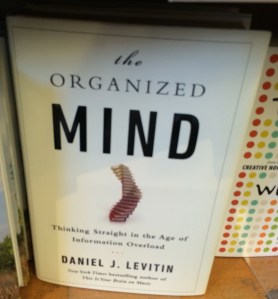
The Organized Mind at the Harvard BookstoreChapter 1

Satisficing is one of the foundations of productive human behavior; it prevails when we don’t waste time on decisions that don’t matter, or more accurately, when we don’t waste time trying to find improvements that are not going to make a significant difference in our happiness or satisfaction.

…satisficing is a tool for not wasting time on things that are not your highest priority…

…unproductivity and loss of drive can result from decision overload.

The decision-making network in our brain doesn’t prioritize.

Every status update you read on Facebook, every tweet or text message you get from a friend, is competing for resources in your brain with important things like whether to put your savings in stocks or bonds, where you left your passport, or how best to reconcile with a close friend you just had an argument with.

Attention is the most essential mental resource for any organism. It determines which aspects of the environment we deal with, and most of the time, various automatic, subconscious processes make the correct choice about what gets passed through to our conscious awareness.

…attentional switching. We can state the principle this way: Switching attention comes with a high cost.

Our brains evolved to focus on one thing at a time.

The formation of categories in humans is guided by a cognitive principle of wanting to encode as much information as possible with the least possible effort

We are hardwired to impose structure on the world

…shift the burden of organizing from our brains to the external world. Continue reading
Exploring Livable Streets, Environmental Art and Workspace Layout at A Better World By Design 2014

So back in the summer, I was trying to decide whether I should attend if it’s worthwhile to attend the design conference A Better World by Design (AWBxD). Now, here I am on the campuses of RISD and Brown University attending conference talks and workshops! While some of the workshops are quite amateur in nature (i.e. feel not well developed and not well facilitated), some of the ABWxD speaker sessions and other workshops have been fantastic. Here are a few of my faves so far…

Aaron Naparstek got us well acquainted with livable streets, showcasing some amazing urban re-design work from around he world and particularly in NYC, improvements to cities that allow them to better integrate bicycles, pedestrians and green space to become more lively.

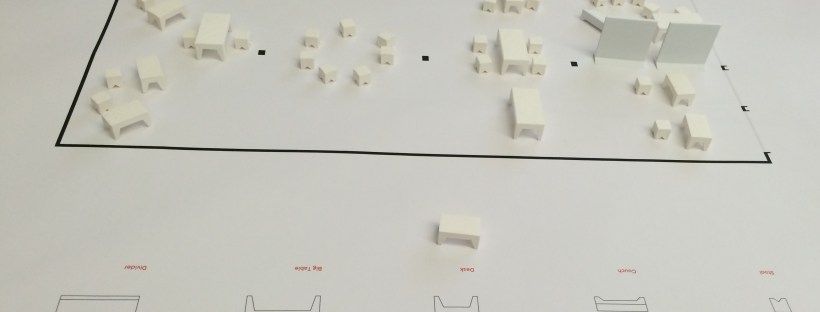
The folks from Work-Shop kicked of their session by giving us a super-basic floor plan and 3D-printed model furniture and having us work in small groups Continue reading

Summer Reading Suggestions: Nonfiction

Looking for a beach-bag, in-flight or in-hammock book that offers cutting-edge, even actionable ideas, instead of literary escapism? Here are some paradigm-shifting books I have been enthralled by and continue to use personally and professionally. Enjoy!

Creative Productivity

Glimmer (aka CAD Monkeys, Dinosaur Babies and T-Shaped People)

By 99u.com: Manage Your Day-to-Day, Maximize Your Potential—excellent guidance on how to be an effective creative professional

Steal Like an Artist

Getting the Right Work Done

Do More Great Work—the workbook for making the work you care about even better

The Nature of Thought, Human Behavior and the World

The Heath Brothers Trilogy: Made to Stick, Switch, Decisive—effective strategies for communicating, driving behavioral change and making decisions based on psychology research, explained clearly with compelling stories

The Social Conquest of Earth—the story of who we are as species, why we can be so kind and so hostile (http://www.npr.org/2012/04/13/150575003/how-humans-and-insects-conquered-the-earth)

Your Brain on Nature—how we’re healthier with nature (and some explanation of why)

Leaders Eat Lastthe anthropology and neurobiology of leadership

Imagine, how creativity works (http://www.npr.org/2012/03/21/148607182/fostering-creativity-and-imagination-in-the-workplace)

Where Good Ideas Come From

The Rise of Supermanthe neurobiology of flow through the lens of extreme sports

Antifragile—systems can be more than resilient; rather than bounce back from disruption, some can be made stronger by it; enter antifragility

Focus: the hidden driver of excellence—“The more you can concentrate, the better you’ll do in anything, because whatever talent you have, you can’t apply it if you’re distracted.” http://www.kqed.org/a/forum/R905131000

The Power of Habit—the anatomy of habits (http://www.npr.org/2012/03/05/147192599/habits-how-they-form-and-how-to-break-them)

The Paradox of Choice—how more choices actually make us less happy (http://www.npr.org/2012/05/02/151881205/the-pursuit-of-happiness)

The Willpower Instinct

Your Brain at Work

Ha! The Science of When and Why We Laugh—“humor is by nature confrontational—sometimes cognitively, sometimes emotionally, and sometimes both” (http://www.npr.org/2014/03/15/289946192/whyd-the-scientist-cross-the-road-to-figure-out-why-youre-laughing)

The Information Diet (http://www.informationdiet.com/; http://www.npr.org/2012/01/14/145101748/is-it-time-for-you-to-go-on-an-information-diet)

The 5 Elements of Effective Thinking

The As If Principle

The Social Animal

Disciplined Entrepreneurship

Writers Need Mission Statements Too—Lessons from The Muse and The Marketplace 2014

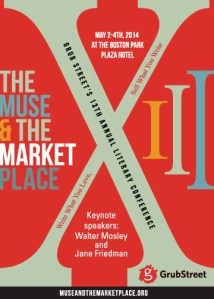
muse2014posterPushing us to take a hard look at the pursuit of writing as a career, the conference session “The Strategic Writer” provided some realistic, practical perspective for writers in any stage of their development. Led by literary agent Eve Bridburg, the session took us through a framework for approaching writing with clearer purpose and direction, ultimately allowing us to find the viable paths and then select the best ones—reminds me of the quote from Émile-Auguste Chartier shared in Do More Great Work, “Nothing is more dangerous than an idea when it’s the only one you’ve got.”

Two major components of the framework are

  • Define Your Mission: Why do you write? What do you seek to achieve? What impact should your work have?

and

  • Define Success: Qualitatively and quantitatively describe how you’ll know you’re achieving the mission. In doing so, think about what gives enriches your life and you energy; don’t set a target that doesn’t resonate with you (e.g. having 2,000 followers on Twitter when you hate tweeting). For example, if knowing you’ve connected with readers helps sustain your spirits and work, make sure you have at least one way to hear from them that works for you; as one attendee said, a handful of positive emails can actually be powerful indicator that you’ve achieved or are on your way to achieving your mission of sharing valuable perspectives.

These points Eve discussed immediately reminded me of concepts from the invaluable books Made to Stick and Switch, especially

  • the core: clearly capture and convey the essence of your idea

and

  • point to the destination: have a picture of what the near future looks like if your goal is achieved.

The session also resonated with points made in Kevin Starr’s PopTech talk “Lasting Impact” which I require all of my Intro to Environmental Science students watch and apply. Clarity of mission can make all the difference.

Kevin Starr: Lasting Impact from PopTech on Vimeo.

Make Computer Work Easier on Your Eyes

flux-icon-smWhen I showed my friend how to toggle her iMac’s display from vivid color to grayscale, she said it was as though her eyes said “ahhhh“—the sound of relief, that is, not horror.

“If you think that’s nice,” I then said. “You have to use f.lux.”

Here are a few things I like to do on every computer I regularly use to make the experience more comfortable for my eyes:

  • Use grayscale: when I’m working on something that doesn’t need or benefit from color (like writing this blog post), I turn on the “Use grayscale” option in my Mac’s System Preferences (it’s under Accessibility).
  • Install f.lux: this free app automatically adjusts the color temperature of my display based on the time of day, so that it’s got a gentle, warm glow in the evenings. I love this little app; without it, computer displays feel really visually harsh to me at night.
  • Enlarge the cursor: I feel like it’s much easier Continue reading

Steven Kolter on the Mechanics of Flow

From Warren Berger's enthralling book CAD Monkeys, Dinosaur Babies and T-Shaped People (formerly, Glimmer)

From Warren Berger’s enthralling book CAD Monkeys, Dinosaur Babies and T-Shaped People (formerly, Glimmer)

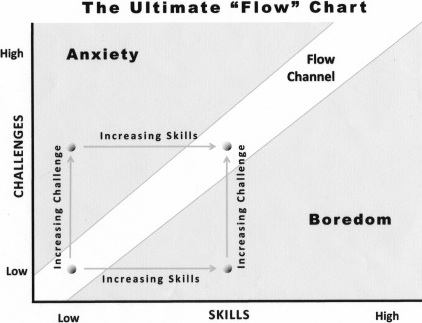
Ever since reading CAD Monkeys, Dinosaur Babies and T-Shaped People—that incredible book on the world of design and power of design thinking by Warren Berger—I often refer back to and share its clear description and helpful chart on the mental state of flow (some times referred to as being “in the zone”).

According to Mihály Csíkszentmihályi, the condition of “flow” is characterized by being totally immersed and completely engaged in what you are doing, to the extent that time seems to stop. People who are in a state of flow “experience intense concentration and enjoyment, coupled with peak performance,” he says.

Now, I’ll also undoubtedly be sharing information from (as well as recommending) Steven Kolter’s book The Rise of Superman when talking with friends and colleagues about creativity and performance. This book is all about flow, primarily through the lens of extreme athletics, and if those topics interest you, you might enjoy the latest Accidental Creative podcast in which Steven Kolter and Todd Henry discuss research findings on the neurobiology of flow and the scientific picture we now have of this amazing phenomenon. Even while groggy after hours of traveling, I was enthralled by this interview and will definitely be listening to it again very soon.

What you want to have eaten vs. what you want to eat: Peter Bregman’s Buffet Problem

Dan Heath’s interview with Peter Bregman nicely describes the disconnect between what we want to have done (made progress on our creative projects, spent quality time with family, jogged a few miles for exercise, etc.) and what we want to do (check our email, veg out with TV, etc.). Much like a lunch buffet presenting us with a variety of food options, life constantly confronts us with different kinds of activities we could do. This analogy provides some helpful perspective on the competition between long-term interests (stay healthy with fiber and nutrients from vegetables) and short-term desires (gratify our palates with cheese-covered Tater Tots).

From there, the conversation heads into deeper examination of this disconnect and simple, effective strategies to remedy it, interweaving ideas from Switch and Decisive. If you’re familiar with those excellent books on behavioral change and decision making, I think you’ll appreciate the helpful context they add to the discussion—the amazingly effective Rider, Elephant, Path metaphor for behavior is once again incredibly useful. Overall, it’s a great 30 minutes of dissecting the problems and considering solutions.

If you’re looking a way to stay focused on achieving large, important goals and minimizing time lost to less pressing activities (avoiding the perils of what Todd Henry calls “fake work”), give this interview a listen!

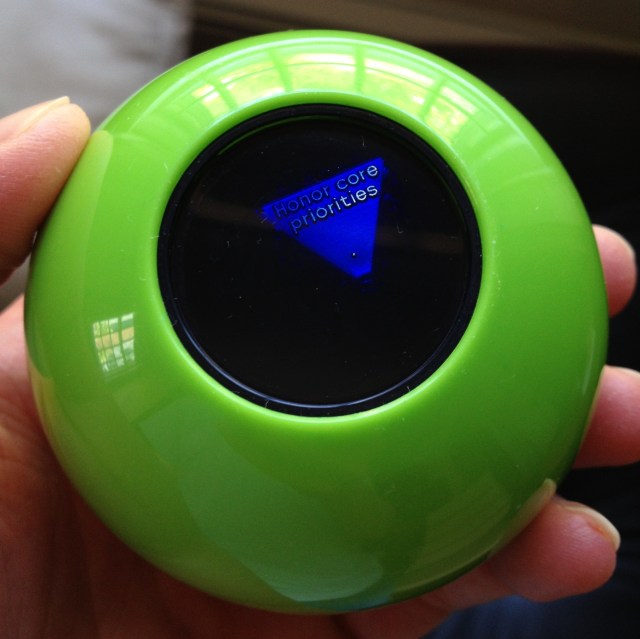
decisive ball

Simon Sinek and the Story of Leadership

This 99u session by Simon Sinek is just phenomenal. Compelling examples, excellent humor and fascinating neurobiology come together to describe who we are and how we become leaders.

Earlier this week, in hopes of connecting the nano to the macro, I showed this to some undergraduate biochemistry students who were learning about neurotransmitter structure and function. They were enthralled, and I likely got a jolt of serotonin and maybe even some oxytocin too.

Love you, 99u!!

Schedules Over Deadlines: Roald Dahl, Anna Akana, iDoneThis

I couldn’t help but notice that recently shared perspectives from Roald Dahl, Anna Akana and iDoneThis hammer the importance of being disciplined, building routines or a schedule and having realistic short-term goals as keys to producing creative work.

Reminds me of what Ira Glass said in an interview (below) about how to close the gap between where your work is and where you want it to be: “do a huge volume of work… so that every week or every month you know you’re going to finish one story.”

Here is the excellent All Things Considered story “Roald Dahl Wanted His Magical ‘Matilda’ To Keep Books Alive” which reveals some of Roald Dahl’s writing habits.