Category: Fiction
Still Incredible: The Lifecycle of Software Objects
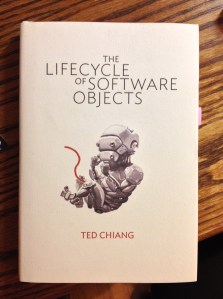
But perhaps the standards for maturity for a digient shouldn’t be as high as they are for a human; maybe Marco is as mature as he needs to be to make this decision. Marco seems entirely comfortable thinking of himself as a digient rather than a human. It’s possible he doesn’t fully appreciate the consequences of what he’s suggesting, but Derek can’t shake the feeling that Marco in fact understands his own nature better than Derek does. Marco and Polo aren’t human, and maybe thinking of them as if they were is a mistake, forcing them to conform to his expectations instead of letting them be themselves. Is it more respectful to treat him like human being, or accept that he isn’t one?
From The Lifecycle of Software Objects.
This book feels just as amazing as when I first read it about three years ago. That’s almost undoubtedly because we’re still wrestling with how to achieve and think about human-like artificial intelligence, and author Ted Chiang has done a fantastic job grappling with the latter. In a nutshell, the story he tells is about the creation and growth of AI beings called digients, but there are so many great layers wrapped around that basic core, including questions of identity, maturity, sexuality, responsibility—you know, all the deep stuff we’ve contemplated about ourselves for ages. Ted Chiang really knows how to impressively weave cutting-edge and age-old ideas together in this enthralling work of fiction so they come across as intriguing and intuitive. I only wish that the voice of the book were a bit more “show” than “tell”, but this approach makes for a fast-moving, epic-feeling novella (hardcover version is only 150 pages).
The passage above comes at a critical turning point in the book where the humans and digients are grappling with an attractive but disconcerting proposition that will permanently and fundamentally change the nature of some digients and their interactions with people.
If You Have Some Time to Kill, I’ve Got an Axe to Grind
Snow began to fall.
Diana was approaching the darkest hour, and she knew it was her or the hour.
Only one could be loved.
Engineering Gratefulness
While rain fell, Diana devised three ways never to be taken for granted again. Only one included gravitational lensing.
Food for thought
Eating corn flakes, Diana ruminated on the infinity of blue hues. Would it matter, she wondered, if she could only perceive 32 instead of 51?
Fluid Intake
While others swilled apathy, Diana sipped curiosity, savoring the nuances, though her thirst for knowledge was seldom fully quenched.
Setting Us Straight
To our delirious delight, Diana proved us all wrong, extravagantly. We would never make the same errors in reasoning about air kissing again.
Regret, Soon Amplified
Diana forwent the macaroni and cheese only to wish she hadn’t ten minutes later.
Then aliens came and ran amok.
Afraid to be Rude
As she talked, it seemed like her mouth was full of saliva, some spilling out at the corners.
I wanted to look away but didn’t.
In the Voluptuous Room
Urgal leaned upon and fondled a gently undulating bulge of wall.
Diana wanted to talk about passive activism but couldn’t.
 A Contemplative Compilation