Game Changing: the latest from The Story of Stuff

The latest installment of The Story of Stuff, “The Story of Solutions,” is an accessible, even empowering fresh framing of familiar environmental and social issues. Although we’ve bemoaned the shortcomings of GDP as a progress indicator for quite some time, Annie Leonard does an amazing job of explaining this and offering a path forward in just under 10 minutes!

While the analogy of the economy as a game used in “The Story of Solutions” is simple, it’s remarkably effective in its intuitiveness and provides insight for action. I also love that excellent examples of what is working (what Dan and Chip Heath call bright spots in Switch) are mentioned in this video to give us a sense of what we can do now. And speaking of Dan and Chip Heath, with this video The Story of Stuff Project, once again, nails nearly every dimension of stickiness in the Made to Stick SUCCES model. Awesome.
Gravity is as good as (or better than) they say it is

In his Fresh Air film review, David Edelstein is right on about Alfonso Cuarón’s Gravity. As is The Verge in theirs. There’s been so much good press and word of mouth about this film, I couldn’t help but enter the movie theater with high expectations. But Gravity surpasses all of them. I know people can fuss over the scientific accuracy, but its utterly, mind-blowingly convincing realness in its luminous, looming hugeness in the darkness of a cinema is so epically engrossing, suspension of all disbelief is easily achieved.

If you haven’t seen it yet, you should. Preferably without watching any of the trailers, like the one below.

Fixing What We Broke: the 5th National Conference on Ecosystem Restoration

NCER conference banner

Or maybe it should be “healing what we’ve hurt”. The 5th National Conference on Ecosystem Restoration (NCER) just ended yesterday in Schaumburg, IL with

  • David Doig, President of the Chicago Neighborhoods Initiative, talking about projects going on in Chicago, particularly their work on Pullman Park, and
  • David Donnenfield and Kevin White of Full Frame Productions sharing their work and perspectives on the vital role of storytelling in ecological restoration (the trailer for their excellent film A Simple Question is below).

NCER5 has been an intense four days of presentations, panel discussions, plenary sessions, posters, networking and excellent food. While it’s been great hearing about the work happening in so many places, I’m reminded that there’s still much to be done: more places to work on, people to reach, money to be raised.

Although I am alternatingly skeptical and enthusiastic about bringing business approaches to traditionally non-business enterprises (e.g. education, public infrastructure, etc.), I left the conference thinking that we need to figure out how to make ecological restoration profitable, beyond firms getting contracts from the government for restoration projects. There just isn’t enough public funding to do the kind of work that is needed, and businesses need to step up and do their share, and if money can be fairly made in a way that supports the environment, community and economic growth, let’s go for it. Social enterprise could be a great way for the field of ecological restoration to head.

What the appendix does, where cows came from and more—The Wild Life of Our Bodies

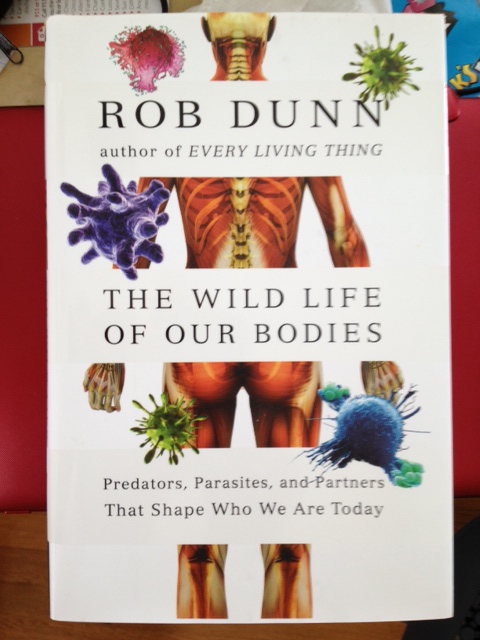
Wild Life of Our Bodies, coverThe moment that made us human in that series of happenings was not the language, the gods, or even the ability to draw Rubenesque women in stone. It was when we decided that when a leopard stalked the cave, we ought to go after it and kill it. When we decided to kill a species not for food or in self-defense, but instead in order to control what lived and what did not live around us, when we did that we were then fully human. From The Wild Life of Our Bodies.

Listening to a recent Science Friday interview with Dr. Rob Dunn, I was enthralled by the discussion of who we share our homes and bodies with on a microscopic level. Yearning to find out more about the variety of relationships we have with other organisms, I got a copy of Dr. Dunn’s book The Wild Life of Our Bodies which is a fascinating collection of stories about the organisms that make us who we are and how they and we have changed each other over time. Continue reading