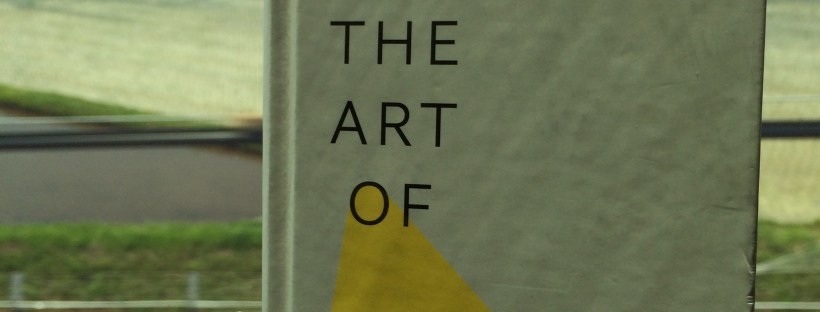
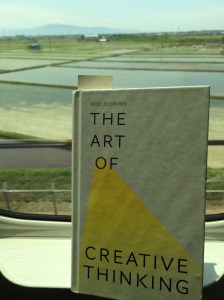
Currently Reading: The Art of Creative Thinking

IMG_5548

A creative person can’t refuse to grow old but they can refuse to grow up. They maintain the playful attitude of a child throughout their lives. They understand that some things are too serious to take seriously. They never lose the urge to throw a snowball at a businessman. All creativity is about mind over matter. That matter might be paint, ink, paper or almost anything. The matter doesn’t matter, because it’s all in the mind.

Rod Judkins’ The Art of Creative Thinking is a fantastic collection of thematic stories, perspectives, quotes and guidance. A great philosophical complement to Austin Kleon’s more pragmatically oriented Steal Like an Artist. That’s not to say that The Art of Creative Thinking is all theoretical, but it excels at conveying an attitude toward creativity, as opposed to getting into the mechanics of doing creative work. Continue reading
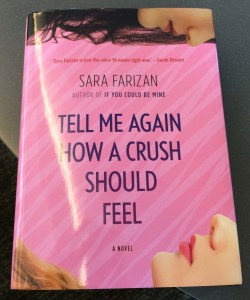

just read: Tell Me Again How a Crush Should Feel

IMG_5528 Wow. Just… wow.

Read this novel all in one sitting, so attached to several of the main characters, even the, well, I don’t want to give anything away. There are some nice surprises in this story.

Here are a few not-so-revealing passages that struck me…

I was heartbroken. I threatened almost every country at the conference with whatever military capabilities Algeria had. My other group members had to appease everyone afterward by offering to export…

Lisa manipulates mannequin arms into lewd positions whenever she has the chance.

I’m always going to think of Ms. Taylor as one of my first big crushes, albeit a teacher crush, but now she’s more like a friend. She does look superhot, thought.

Log Lines and What Editors & Agents Look for: Lessons from #muse2015

logo@2xHere’s a glimpse at my faves from The Muse and the Marketplace 2015, a high-energy weekend at the Park Plaza Hotel devoted to writing and publishing.

Sell Your Story in a Single Sentence with Lane Shefter Bishop: Craft a great log line to pitch your book. The log line must answer these three questions:
1. Who is the protagonist? (Who is the story about?)
2. What does the protagonist want?
3. What are the stakes? (What will happen if the protagonist does not get what she/he is after?)
And these three questions should be answered in a way that
– highlights the most unique aspect of your work (what sets it apart from everything else out there?),
– uses active, dynamic language Continue reading

Open Notebook: quotes from the TED Radio Hour

Follow your curiosity. Because passion is sort of a tower of flame that is not always accessible, and curiosity is something that anybody can access any day. Your curiosity may lead you to your passion or it may not—it may have been “for nothing” in which case all you’ve done your entire life is spend your existence in pursuit of the things that made you feel curious and inspired, and that should be good enough. Like if you get to do that, that’s a wonderful way to have spent your time here.—Elizabeth Gilbert

TED Radio Hour logoTED talks are always a great source of new and insightful perspectives, and I love how NPR’s TED Radio Hour takes us deeper into

“… if you live with your head in the clouds every now and then, it helps you keep your feet on the ground.”—Gavin Pretor-Pinney

“When you say `creative people,’ that’s redundant. We are creativity.”—Elizabeth Gilbert

“…forget about having an identity crisis and get some identity capital. By `get identity capital,’ I mean do something that adds value to who you are. Do something that’s an investment in who you might want to be next… Identity capital begets identity capital.”—Meg Jay
That’s from her talk “Why 30 is not the new 20”, but check out Meg Jay’s Q&A on NPR.org.

“Science is curiosity acted upon.”—James Cameron

Open Notebook: The Cambridge Introduction to Creative Writing

Here are some perspectives David Morley shares in his fantastic book The Cambridge Introduction to Creative Writing. 

Writing proceeds forwards slowly, like a sand dune moving through night and day, simultaneously accreting and eroding. Much is lost or invisible, millions of grains of sand, millions of grains of language

You have now begun to walk in the open space of the page. The journey becomes an elaborate series of gambles, and there is no sense of forward progression as such; there is shaping and reconfiguring, stepping back, inking in and beginning over.

A notebook is a movable workplace… A notebook will make the difference between a book being born and one that never achieves conception.

…we have to use the right words and the right words in the best order.

Most writers agree that the best way to write well creatively is to write for yourself.

It follows that the best way to read as a writer is to read for yourself.

Open Notebook: The Cambridge Companion to Creative Writing

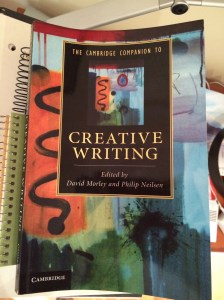
IMG_5141After enjoying David Morley’s fantastic Writing Challenges podcast, I decided to take a look at the book David Morley co-edited with Philip Neilsen, The Cambridge Companion to Creative Writing. Overall, this collection of articles offers some helpful perspectives (ranging from philosophical to practical) and exercises for creative writers. Here are a some lines that resonated with me.
What are you challenging yourself to do that makes it worthwhile for the reader to join you?—Kári Gíslason, “Travel Writing”

Is it not the point of art, both the production and the experience of it,
to transcend your own reality, your own autobiography?—Jewell Parker Rhodes, “Imaginative crossings: trans-global and transcultural narratives”

…to “write what you know” fosters provincialism. —Jewell Parker Rhodes, “Imaginative crossings: trans-global and transcultural narratives”

My admonition is to write what you can dream… write what you wish to discover… write what you need to about human nature. Stories, for me, have always been a wish fulfilment — an opportunity to make my life larger by stimulating my intellect, deepening my empathy, and connecting rather than distancing my self from others.—Jewell Parker Rhodes, “Imaginative crossings: trans-global and transcultural narratives”

…the writing workshop isn’t about being published… it is about being more deeply alive.—A.L. Kennedy, “Does that make sense?”

I currently believe that writing is a way of life, that it is a massively demanding discipline, that it is an almost irresistible source of enrichment, expression and change.—A.L. Kennedy, “Does that make sense?”

Writing consists of a multitude of individual decisions, massive and complex control of language in depth and considerable personal responsibility…—A.L. Kennedy, “Does that make sense?”

Continue reading

Open Notebook: quotes from The Organized Mind

Quotes from the fantastic book The Organized Mind (points that were particularly interesting to me are in bold).

The Organized Mind at the Harvard BookstoreChapter 1

Satisficing is one of the foundations of productive human behavior; it prevails when we don’t waste time on decisions that don’t matter, or more accurately, when we don’t waste time trying to find improvements that are not going to make a significant difference in our happiness or satisfaction.

…satisficing is a tool for not wasting time on things that are not your highest priority…

…unproductivity and loss of drive can result from decision overload.

The decision-making network in our brain doesn’t prioritize.

Every status update you read on Facebook, every tweet or text message you get from a friend, is competing for resources in your brain with important things like whether to put your savings in stocks or bonds, where you left your passport, or how best to reconcile with a close friend you just had an argument with.

Attention is the most essential mental resource for any organism. It determines which aspects of the environment we deal with, and most of the time, various automatic, subconscious processes make the correct choice about what gets passed through to our conscious awareness.

…attentional switching. We can state the principle this way: Switching attention comes with a high cost.

Our brains evolved to focus on one thing at a time.

The formation of categories in humans is guided by a cognitive principle of wanting to encode as much information as possible with the least possible effort

We are hardwired to impose structure on the world

…shift the burden of organizing from our brains to the external world. Continue reading