NaNoWriMo Guidance: Every story is about saving the world

Every story is about saving the world. The only question is: what is the world you’re saving?—Max Gladstone

It’s so fantastic that the Cambridge Public Library has an author speaker series for National Novel Writing Month! The last session on world building with Max Gladstone was fully of lively discussion and great perspectives about creating immersive, coherent worlds in fiction. One point that really stood out to me was a world-centric view of stories that Max mentioned, quoted above. In the days following his talk, I found myself looking at story after story through this lens, considering the sorts of worlds various characters are trying to save—a microcosm of interconnected friendships, the Candy Kingdom, a starship full of spacefaring humans, the inner life and family life of a tween… I love how applicable this way of looking at narratives is.

I wish the NaNoWriMo Author Insights speaker series could go on and on beyond November… Fortunately, it seems like there are always author talks and more on the library calendar!

NaNoWriMo 2015 at Cambridge Main Library

Delightful Media This Week: Hidden Brain, PBS Space Time, TED Radio Hour

Hidden Brain-d4dc2bc0fb94c4fa0074fb7ab2e1b681e6245d7a-s600-c85It’s been another wonderfully stimulating week of public broadcasting. NPR’s Hidden Brain podcast consists entirely of a witty, informative interview of Aziz Ansari by Shankar Vedantam on patterns of romance-related behavior (word of caution: a lot of bleepings in this one), while in another corner of NPR, the TED Radio Hour looks at our ability to change. And PBS Space Time once again does a fantastic job nutshelling intriguing topics, this time laying out how to thwart killer asteroids in not just 1 or 2 but 5 ways!

I love how these podcasts and videos build out the story of who we are as a species.

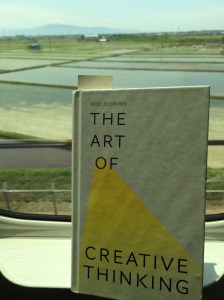
Currently Reading: The Art of Creative Thinking

IMG_5548

A creative person can’t refuse to grow old but they can refuse to grow up. They maintain the playful attitude of a child throughout their lives. They understand that some things are too serious to take seriously. They never lose the urge to throw a snowball at a businessman. All creativity is about mind over matter. That matter might be paint, ink, paper or almost anything. The matter doesn’t matter, because it’s all in the mind.

Rod Judkins’ The Art of Creative Thinking is a fantastic collection of thematic stories, perspectives, quotes and guidance. A great philosophical complement to Austin Kleon’s more pragmatically oriented Steal Like an Artist. That’s not to say that The Art of Creative Thinking is all theoretical, but it excels at conveying an attitude toward creativity, as opposed to getting into the mechanics of doing creative work. Continue reading

Log Lines and What Editors & Agents Look for: Lessons from #muse2015

logo@2xHere’s a glimpse at my faves from The Muse and the Marketplace 2015, a high-energy weekend at the Park Plaza Hotel devoted to writing and publishing.

Sell Your Story in a Single Sentence with Lane Shefter Bishop: Craft a great log line to pitch your book. The log line must answer these three questions:
1. Who is the protagonist? (Who is the story about?)
2. What does the protagonist want?
3. What are the stakes? (What will happen if the protagonist does not get what she/he is after?)
And these three questions should be answered in a way that
– highlights the most unique aspect of your work (what sets it apart from everything else out there?),
– uses active, dynamic language Continue reading

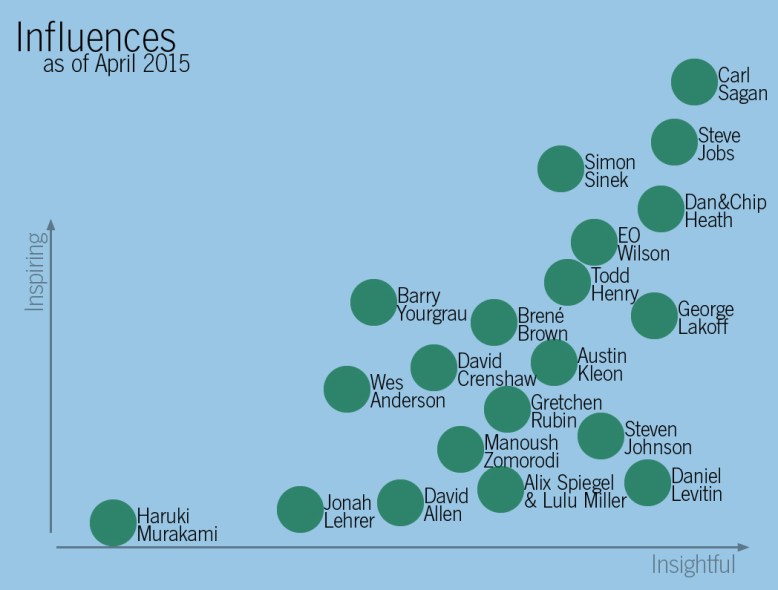
Who Has Impacted Me In Recent Years, At a Glance

"...you gotta watch the ones who you let speak straight into your life..."—Tim McMorris.

“…you gotta watch the ones who you let speak straight into your life…”—Tim McMorris.

Of course this says more about my personality and tastes as well as what I tend to encounter and look for, as opposed to commenting on how “important” or “valuable” the works of these amazing people are. Although it is perhaps concerning that the chart is rather male heavy…

Open Notebook: quotes from the TED Radio Hour

Follow your curiosity. Because passion is sort of a tower of flame that is not always accessible, and curiosity is something that anybody can access any day. Your curiosity may lead you to your passion or it may not—it may have been “for nothing” in which case all you’ve done your entire life is spend your existence in pursuit of the things that made you feel curious and inspired, and that should be good enough. Like if you get to do that, that’s a wonderful way to have spent your time here.—Elizabeth Gilbert

TED Radio Hour logoTED talks are always a great source of new and insightful perspectives, and I love how NPR’s TED Radio Hour takes us deeper into

“… if you live with your head in the clouds every now and then, it helps you keep your feet on the ground.”—Gavin Pretor-Pinney

“When you say `creative people,’ that’s redundant. We are creativity.”—Elizabeth Gilbert

“…forget about having an identity crisis and get some identity capital. By `get identity capital,’ I mean do something that adds value to who you are. Do something that’s an investment in who you might want to be next… Identity capital begets identity capital.”—Meg Jay
That’s from her talk “Why 30 is not the new 20”, but check out Meg Jay’s Q&A on NPR.org.

“Science is curiosity acted upon.”—James Cameron

Open Notebook: The Cambridge Introduction to Creative Writing

Here are some perspectives David Morley shares in his fantastic book The Cambridge Introduction to Creative Writing. 

Writing proceeds forwards slowly, like a sand dune moving through night and day, simultaneously accreting and eroding. Much is lost or invisible, millions of grains of sand, millions of grains of language

You have now begun to walk in the open space of the page. The journey becomes an elaborate series of gambles, and there is no sense of forward progression as such; there is shaping and reconfiguring, stepping back, inking in and beginning over.

A notebook is a movable workplace… A notebook will make the difference between a book being born and one that never achieves conception.

…we have to use the right words and the right words in the best order.

Most writers agree that the best way to write well creatively is to write for yourself.

It follows that the best way to read as a writer is to read for yourself.