Learn, Earn, Return—Lessons from The Muse and The Marketplace 2014

During this year’s The Muse and the Marketplace, Grub Street’s annual writers’ conference, one particular idea struck me immediately and deeply. It was perspective and philosophy not on writing but on career and life. During a discussion on partner publishing, literary agent April Ebhardt mentioned that one’s career and life can be thought of as having 3 stages: Learn, Earn and Return. That seemed like such a clear and practical view.

Undoubtedly, all times in our lives incorporate some combination of learning, earning and returning (I think all are essential to being truly human), but Continue reading

Make Computer Work Easier on Your Eyes

flux-icon-smWhen I showed my friend how to toggle her iMac’s display from vivid color to grayscale, she said it was as though her eyes said “ahhhh“—the sound of relief, that is, not horror.

“If you think that’s nice,” I then said. “You have to use f.lux.”

Here are a few things I like to do on every computer I regularly use to make the experience more comfortable for my eyes:

  • Use grayscale: when I’m working on something that doesn’t need or benefit from color (like writing this blog post), I turn on the “Use grayscale” option in my Mac’s System Preferences (it’s under Accessibility).
  • Install f.lux: this free app automatically adjusts the color temperature of my display based on the time of day, so that it’s got a gentle, warm glow in the evenings. I love this little app; without it, computer displays feel really visually harsh to me at night.
  • Enlarge the cursor: I feel like it’s much easier Continue reading

Happy 400th, HBR IdeaCast!

A leader sees greatness in other people. He nor she can be much of a leader if all she sees is herself.—Maya Angelou

HBR IdeaCast imageThe Best of IdeaCast podcast episode is a great compilation of interview clips sharing perspectives on leadership, values and conduct.

And if you’re looking for more helpful and thought-provoking ideas on professional and personal life, here are some more excellent HBR IdeaCast episodes I still love listening to:

…inventing  and pioneering requires a willingness to be misunderstood for long periods of time.—Jeff Bezos


Currently Playing: Monument Valley

Oh cram this game is amazing. With a wonderfully stylistic visual feel that cleverly incorporates optical illusions along with the sort of problem solving that reminds me of Quell, Edge and Fez, Monument Valley is delightfully engrossing. And the soundtrack is atmospheric, immersive and calming.

Appealing to my predilection for cute, geometric, colorful, quirky, mind-bending minimalism, this is one of the most enthralling, gorgeous games I’ve played in a while.

Open Notebook: back in room 5 with Steve Almond (and Hari Kondabolu, in spirit)

“I don’t tell jokes. That’s a popular misconception. Do you know what I do? I send out little vehicles of truth.”—Hari Kondabolu as Manoj in Manoji.

notes from Funny is the New Deep

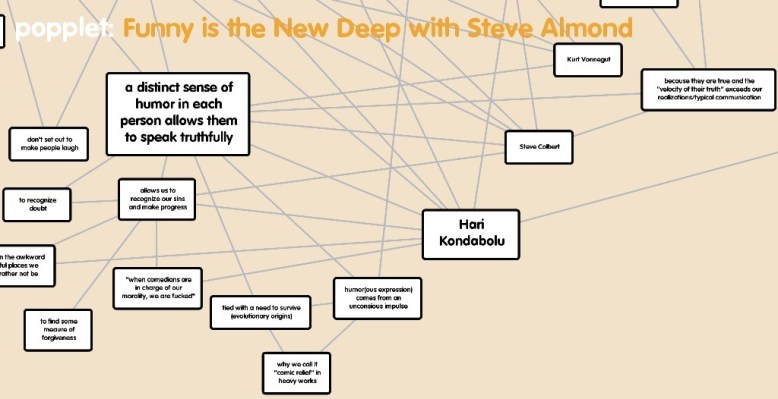
During yesterday’s Grub Street workshop Funny is the New Deep, Steve Almond shared some thought-provoking insights on comedy. Many of them reminded me of Hari Kondabolu‘s comedy, especially these points about the comedic mode/impulse:

  • Comedy allows us to dwell in the awkward, shameful places we would rather not be in at all.
  • Comedy can arise directly from the attempt to contend with tragedy.
  • Comedy allows us to recognize our sins and make progress.

All that and more is manifested in Waiting for 2042, the album Hari just released. I think it’s fantastic, making many important points of its own, but the language can be really strong.

Steve Almond’s perspectives on the relationship between humor and conflict also resonated with a recent Weekend Edition interview with Dr. Scott Weems, author of Ha! The science of when we laugh and why.

In case it’s of interest, here are my notes from Funny is the New Deep taken in Popplet.

And here’s Hari’s recent appearance on the Late Show with David Letterman.

Open Notebook: Maximum Brainpower

IMG_4548There’s a lot of good information and perspective in the excellent brain health book Maximum Brainpower, much of it resonating with Simon Sinek‘s Leaders Eat Last and Steven Kotler’s The Rise of Superman. In case it’s of interest, I thought I’d share some of the ideas from Maximum Brainpower that I’ve jotted down to keep in mind. My note-taking style for books I read for leisure is pretty minimalistic, but I’ve included page numbers (in the 2013 US paperback edition) for the quotes and points below if you’d like to read more about them.

Eustress: stress that stimulates performance, p. 129

“In evaluating the impact of stress, what matters is not the absolute level of stress but the change in stress from a person’s baseline (the level to which he or she is accustomed).” p. 130
“Whether a new situation creates stress or eustress depends largely on our level of preparation. Eustress occurs when we believe we have a good chance at succeeding in the task before us.” p. 130

“…’cognitive appraisal’ posits that if we think we can manage, we are less stressed.” p. 131
2 phases of cognitive appraisal: 1. whether the event is a threat or challenge, 2. can we cope or not?

“…Stanford researchers were shocked to discover that multitaskers were uniformly bad at just about every mental task. They were far more distracted by irrelevant items, had worse memories, and were slower at switching tasks (!) than non-multitaskers. By training themselves to constantly move from one stimulus to the next, they had Continue reading

Steven Kolter on the Mechanics of Flow

From Warren Berger's enthralling book CAD Monkeys, Dinosaur Babies and T-Shaped People (formerly, Glimmer)

From Warren Berger’s enthralling book CAD Monkeys, Dinosaur Babies and T-Shaped People (formerly, Glimmer)

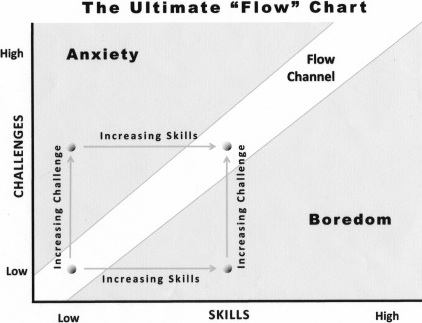
Ever since reading CAD Monkeys, Dinosaur Babies and T-Shaped People—that incredible book on the world of design and power of design thinking by Warren Berger—I often refer back to and share its clear description and helpful chart on the mental state of flow (some times referred to as being “in the zone”).

According to Mihály Csíkszentmihályi, the condition of “flow” is characterized by being totally immersed and completely engaged in what you are doing, to the extent that time seems to stop. People who are in a state of flow “experience intense concentration and enjoyment, coupled with peak performance,” he says.

Now, I’ll also undoubtedly be sharing information from (as well as recommending) Steven Kolter’s book The Rise of Superman when talking with friends and colleagues about creativity and performance. This book is all about flow, primarily through the lens of extreme athletics, and if those topics interest you, you might enjoy the latest Accidental Creative podcast in which Steven Kolter and Todd Henry discuss research findings on the neurobiology of flow and the scientific picture we now have of this amazing phenomenon. Even while groggy after hours of traveling, I was enthralled by this interview and will definitely be listening to it again very soon.

So Real: Adventure Time Season 6, Episode 11

IMG_4510

Wow. Until a few days ago, I had no idea how 15 minutes of cartoon could be so intense. An amazing blend of quirky humor and heartrending humanity in only the way Adventure Time pulls off, “Betty” has immediately become one of my favorites in this series, upping my sympathy for the Ice King/Simon something like 10 fold. Crazy that Betty just comes out of nowhere and just owns the episode. So ridiculously math.
IMG_4512

Also, Flame Princess looks nice with her fire hair down, though it’s a very visible reminder of the current state of her powers.

This episode even more fully realizes what’s portended by this NPR story on the dimensions of meaning in Adventure Time.

A Tour of the Immune System Elements in the Gut—Wow

Worried about potential pathogens in food? The short video below by Nature may assuage some of your concerns, but food safety and personal hygienic practices are of course always important lines of defense.

A beautiful summary of the sophistication of immune system elements in part of the digestive tract, this visual depiction of scientific understanding really ups my appreciation for the amazing processes occurring in the human body. The soundtrack also contributes an epic feel to the whole cellular drama.