Nicely done.
Category: ongoing learning
Is It Time To Geoengineer? Find Out More At Harvard Tomorrow
 Does geoengineering/climate engineering (in the form of altering our atmosphere on a global scale) hold the promise of successfully mitigating climate change?
When I first heard about geoengineering a few years ago via Technology Review, I dismissed it as outlandish and dangerous. After all, we have a bad track record of altering our world on large scales in detrimental ways. Then a few months ago, I attended a talk by David Keith that completely changed my mind. Given the current and future extent of climate change, putting sulfur compounds into the atmosphere to reflect sunlight may be viable and even desirable.
Tomorrow, Alan Robock of Rutgers University shares some views on taking on climate change with climate change during his talk at Harvard entitled “Smoke and Mirrors: Is Geoengineering a Solution to Global Warming?” Whether geoengineering ends up providing a solution that we implement or not, it’s great that we’re exploring and discussing the possibilities it offers.
Diabolically Simple, Fiendishly Unforgiving: Super Hexagon

I’ve spent a sizable chunk of time over the past few days fatiguing my neurons with the iPad/iPhone game Super Hexagon. After finding it in the Impossible Games section of the iTunes Store with a high rating, I decided to spend the $2.99 and go go for it. Impossible indeed. For the first several attempts, I didn’t last more than 3 seconds; the little triangle I was trying struggling to keep from colliding into the lines closing in, that small shape near the center of the screen quickly crashed into the converging stripes as I dizzily fumbled with the controls. Since then, I’ve managed to make it through about 30 seconds of the game.
I love how the game’s concept is so simple, yet the gameplay is unrelentingly challenging. That along with the high-energy, retro-video-game soundtrack keep me coming back for more—and pleasantly getting a little more each time. I didn’t think I’d be able to make it to 30 seconds so soon. Just hope that progress keeps up.
The video below shows what successful gameplay looks like. I can’t believe someone can do that. Then again, it’s pretty amazing what we can train our brains to do.
Splash! 2012 Classes—MIT Gangnam Style Strikes Again!
The magic of Splash! 2012 has come and gone with a little lingering on. The two classes I taught this year, An Introduction to Conceptual Metaphor Theory and An Introduction to Very Short Fiction, went well. The students were of high caliber: very engaged, astute, curious and respectful—impressive! Here’s a couple pieces I wrote during the writing exercises in An Introduction to Very Short Fiction (btw, here are slides for that class):
- In between us there are mellifluous lies, bringing us together and pushing us apart, unsteadily surprising us as some explode in our faces when fragments of truth come along. You in your ruinous foggy sweater this wintry morning would have it no other way, for the bonds of fiction and fallacy offer so much possibility when it’s cold.
- He wallowed in Trisha’s couch, resolutely. Until she got home. Then they played chess for hours, to prepare for tomorrow.
Can’t wait until Spark! 2013.
Oh yes—I sat in on the Splash! Cognitive Neuroscience class, which opened with MIT Gangnam Style!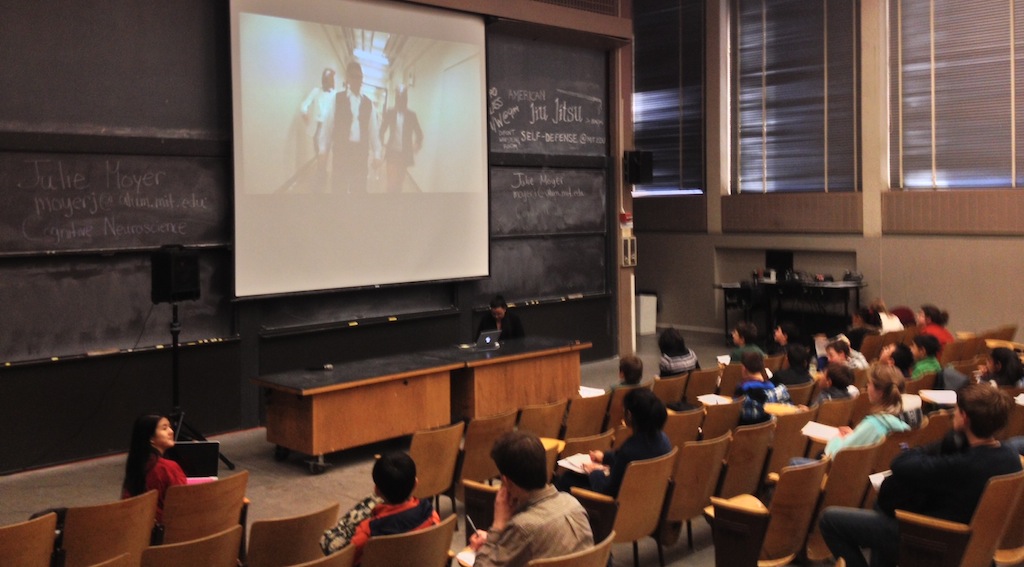
At Splash! 2012
I’m back at MIT to teach Splash! classes for the Educational Studies Program (ESP) this wondrous weekend when middle and high school students converge on the MIT campus to take classes from volunteer teachers on topics that interest them, ranging from origami to black holes to parasitic wasps to the science of cooking. The atmosphere in the student-and-parent-packed hallways of the Infinite Corridor is charged with enthusiasm, while the Splash HQ (where I just checked in) is partly frenetic and casually jovial with lots of underlying camaraderie.
I’ve been volunteer teaching for Splash! and ESP on and off for over ten years now, and I keep coming back to do more. I’ve never seen or heard about anything like what ESP does, and it still amazes me that every year, the students who comprise ESP successfully organize this weekend-long celebration of sharing knowledge, passion and energy.
ESP officers, staff, etc. past and present, I love your dedication to connecting those who want to teach with those who want to learn. Thank you for making learning fun and accessible to so many!

Perhaps I’ll post thoughts on my classes here later.
EmTech 2012: another great conference
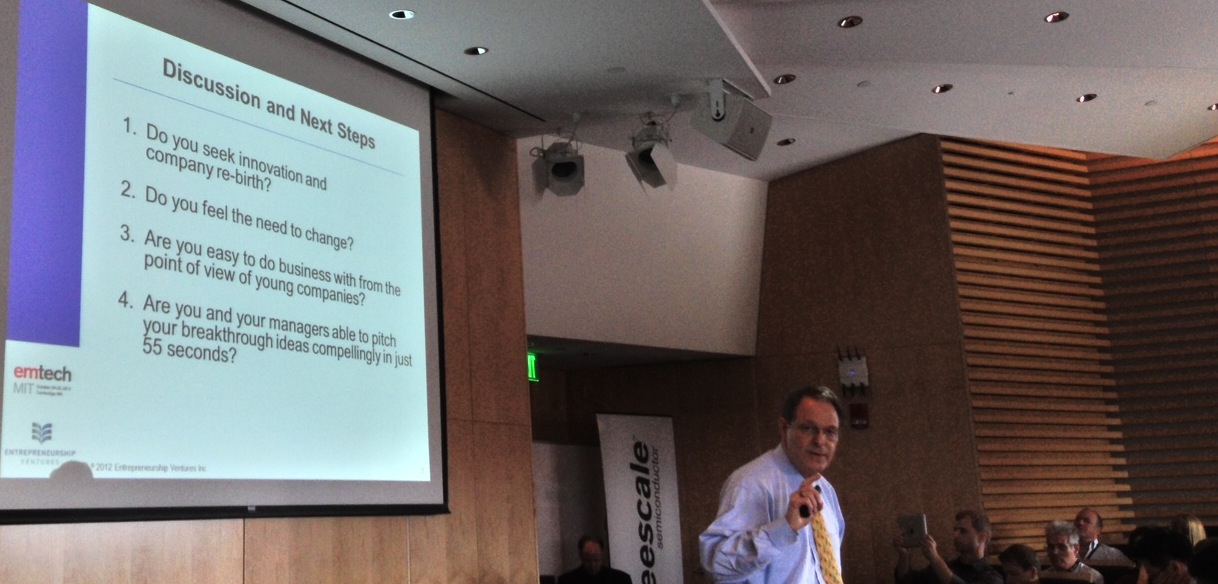 This past week, I spent a handful of high-quality hours at the EmTech MIT 2012 technology innovation conference. The kind of cutting-edge work people are doing these days is utterly mind-blowingly delightful, and the sort of innovation advice (with a hefty dose of humor) from experts like Ken Morse is greatly valuable (image on the left from his session). I wish people outside venues like EmTech could get a glimpse of how amazing things like pop-up book microscale manufacturing and Lytro cameras are—more of a glimpse than is offered by magazines like Technology Review (which organizes EmTech), Scientific American and WIRED. They do a great job, but there’s a raw, awe-inspiring power to hearing innovators talking passionately in-person about moving their ideas into realities. That should be part of public-school curricula.
 A Contemplative Compilation