Wow. It is utterly amazing that we understand the universe in such rich detail. This video by Nature is just fantastically stunning.
Random Anthropomorphism: phragmites
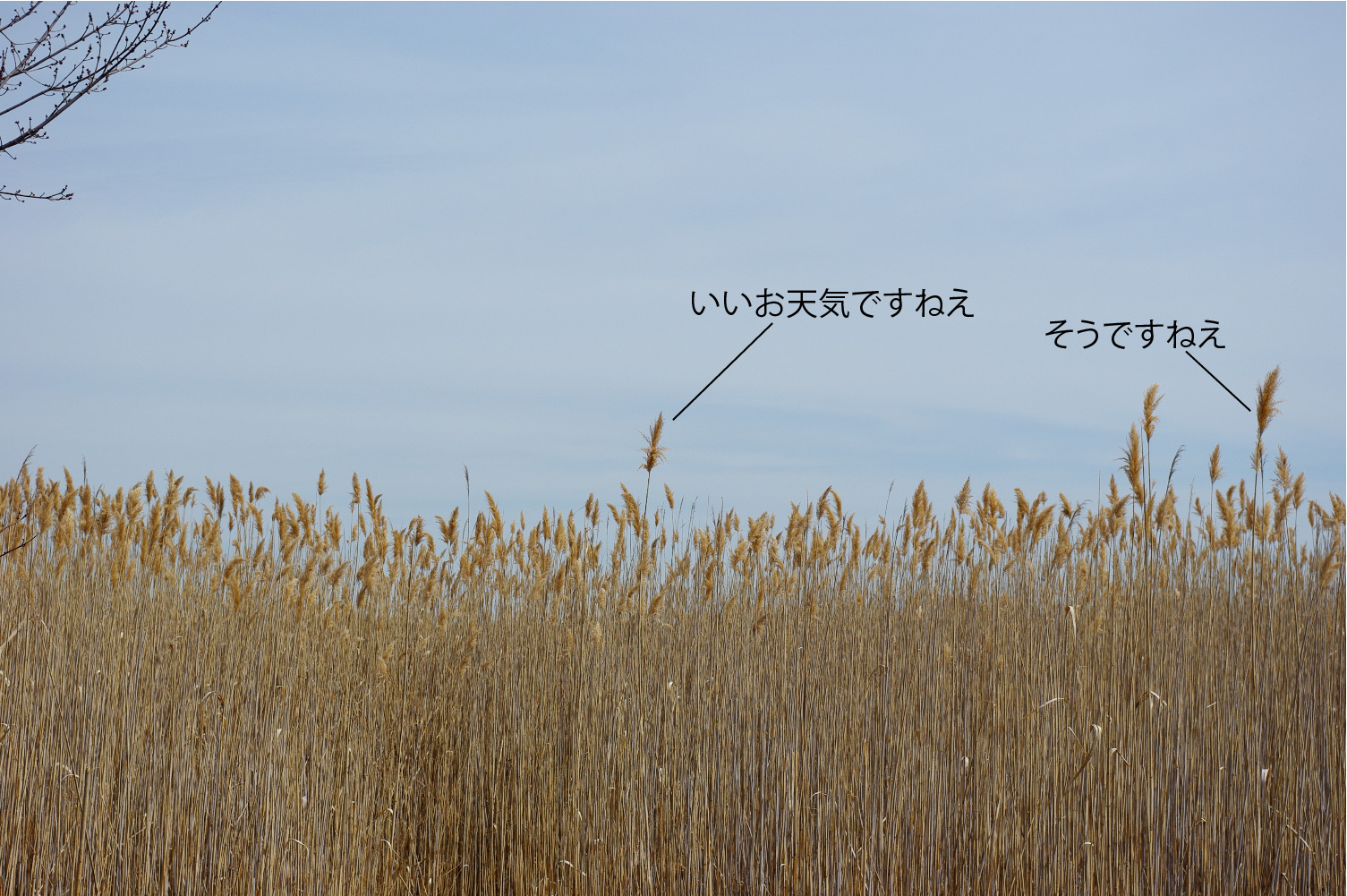
Phragmites: If they could talk, what would they talk about? Would they be friends or just acquaintances? What’s their outlook on life?
Great Way to Learn Some Neuroanatomy
Recently, I’ve been watching UBC Medicine’s Neuroanatomy video series on YouTube, and they are fantastic! Totally cerebral, sometimes literally so. Videos tend to be between 7 – 15 minutes long and effectively convey essential concepts with a combination of clearly shown, well labeled brain specimens and concise, friendly explanations.
Here’s their video on the basal ganglia.
Learn, Earn, Return—Lessons from The Muse and The Marketplace 2014
During this year’s The Muse and the Marketplace, Grub Street’s annual writers’ conference, one particular idea struck me immediately and deeply. It was perspective and philosophy not on writing but on career and life. During a discussion on partner publishing, literary agent April Ebhardt mentioned that one’s career and life can be thought of as having 3 stages: Learn, Earn and Return. That seemed like such a clear and practical view.
Undoubtedly, all times in our lives incorporate some combination of learning, earning and returning (I think all are essential to being truly human), but Continue reading
Make Computer Work Easier on Your Eyes
 When I showed my friend how to toggle her iMac’s display from vivid color to grayscale, she said it was as though her eyes said “ahhhh“—the sound of relief, that is, not horror.
“If you think that’s nice,” I then said. “You have to use f.lux.”
Here are a few things I like to do on every computer I regularly use to make the experience more comfortable for my eyes:
- Use grayscale: when I’m working on something that doesn’t need or benefit from color (like writing this blog post), I turn on the “Use grayscale” option in my Mac’s System Preferences (it’s under Accessibility).
- Install f.lux: this free app automatically adjusts the color temperature of my display based on the time of day, so that it’s got a gentle, warm glow in the evenings. I love this little app; without it, computer displays feel really visually harsh to me at night.
- Enlarge the cursor: I feel like it’s much easier Continue reading
Happy 400th, HBR IdeaCast!
A leader sees greatness in other people. He nor she can be much of a leader if all she sees is herself.—Maya Angelou
 The Best of IdeaCast podcast episode is a great compilation of interview clips sharing perspectives on leadership, values and conduct.
And if you’re looking for more helpful and thought-provoking ideas on professional and personal life, here are some more excellent HBR IdeaCast episodes I still love listening to:
- Taking Control of Your Time
- Can You “Manage” Your Family?
- Whole Foods’ John Mackey on Capitalism’s Moral Code
- Managing the Productivity Paradox
- Yes, Business Relies on Nature
- In a Fast World, Think Slowly
- What Successful People Do Differently
…inventing and pioneering requires a willingness to be misunderstood for long periods of time.—Jeff Bezos
Currently Playing: Monument Valley
 Oh cram this game is amazing. With a wonderfully stylistic visual feel that cleverly incorporates optical illusions along with the sort of problem solving that reminds me of Quell, Edge and Fez, Monument Valley is delightfully engrossing. And the soundtrack is atmospheric, immersive and calming.
Appealing to my predilection for cute, geometric, colorful, quirky, mind-bending minimalism, this is one of the most enthralling, gorgeous games I’ve played in a while.
Open Notebook: back in room 5 with Steve Almond (and Hari Kondabolu, in spirit)
“I don’t tell jokes. That’s a popular misconception. Do you know what I do? I send out little vehicles of truth.”—Hari Kondabolu as Manoj in Manoji.
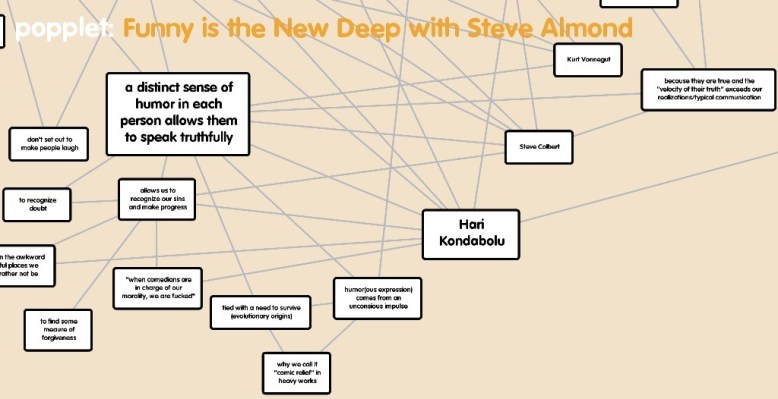
During yesterday’s Grub Street workshop Funny is the New Deep, Steve Almond shared some thought-provoking insights on comedy. Many of them reminded me of Hari Kondabolu‘s comedy, especially these points about the comedic mode/impulse:
- Comedy allows us to dwell in the awkward, shameful places we would rather not be in at all.
- Comedy can arise directly from the attempt to contend with tragedy.
- Comedy allows us to recognize our sins and make progress.
All that and more is manifested in Waiting for 2042, the album Hari just released. I think it’s fantastic, making many important points of its own, but the language can be really strong.
Steve Almond’s perspectives on the relationship between humor and conflict also resonated with a recent Weekend Edition interview with Dr. Scott Weems, author of Ha! The science of when we laugh and why.
In case it’s of interest, here are my notes from Funny is the New Deep taken in Popplet.
And here’s Hari’s recent appearance on the Late Show with David Letterman.
Open Notebook: Maximum Brainpower
 There’s a lot of good information and perspective in the excellent brain health book Maximum Brainpower, much of it resonating with Simon Sinek‘s Leaders Eat Last and Steven Kotler’s The Rise of Superman. In case it’s of interest, I thought I’d share some of the ideas from Maximum Brainpower that I’ve jotted down to keep in mind. My note-taking style for books I read for leisure is pretty minimalistic, but I’ve included page numbers (in the 2013 US paperback edition) for the quotes and points below if you’d like to read more about them.
Eustress: stress that stimulates performance, p. 129
“In evaluating the impact of stress, what matters is not the absolute level of stress but the change in stress from a person’s baseline (the level to which he or she is accustomed).” p. 130
“Whether a new situation creates stress or eustress depends largely on our level of preparation. Eustress occurs when we believe we have a good chance at succeeding in the task before us.” p. 130
“…’cognitive appraisal’ posits that if we think we can manage, we are less stressed.” p. 131
2 phases of cognitive appraisal: 1. whether the event is a threat or challenge, 2. can we cope or not?
“…Stanford researchers were shocked to discover that multitaskers were uniformly bad at just about every mental task. They were far more distracted by irrelevant items, had worse memories, and were slower at switching tasks (!) than non-multitaskers. By training themselves to constantly move from one stimulus to the next, they had Continue reading
The Value of Workshopping, or Aulet and Almond on Working Toward Your Ambitions
“[Y]ou will learn a lot from playing against someone slightly better than you. If you start by playing against a top professional, you will learn only that the professional is very good at the sport—you might as well be watching from the sidelines.”—Bill Aulet, Disciplined Entrepreneurship
“What you must do is read the work of other unpublished writers, the ones who make the same mistakes you do… And actually, just reading these pieces won’t do. You have to critique them.”—Steve Almond, This Won’t Take But a Minute, Honey.
I recently encountered the two perspectives above, these pieces of advice from different fields resonating with each other in my thoughts to incite a gradual, mini-mental-paradigm shift.
We know how important it is to be in the company of masters, in person and through their work. In fact, we’re perhaps hyperaware of this because of constant reminders that continue to bake the learn from the best mindset into our culture of creativity. According to Austin Kleon in Steal Like an Artist, “You’re only going to be as good as the people you surround yourself with.” In Jiro Dreams of Sushi, Jiro Ono tells us, “In order to make delicious food, you must eat delicious food. The quality of ingredients is important, but you need to develop a palate capable of discerning good and bad. Without good taste, you can’t make good food.”
But there’s also value in eating the food that’s trying to be good, engaging work that’s clearly aspiring to be excellent but somehow falling short. That’s another way of exercising and thereby cultivating discernment. The key here is to, as Steve Almond tells us, be able to articulate how the work is falling short. I realize now that honing this ability has served my colleagues and I well, consistently. Don’t forget what lies between immersion in your own writing and mentorship from masters: pushing and being pushed by your peers.
The power of productive workshopping lies in the effective intermingling of different portions of this spectrum.
 A Contemplative Compilation